Maintaining cold chain integrity from Chinese orchard to foreign warehouse is the difference between premium quality and total loss. One temperature excursion can destroy an entire shipment. This guide explains cold chain food safety requirements for citrus exports, with practical protocols and compliance checklists.
| Quick Answer | Key Facts |
|---|---|
| Ideal storage temperature | 4-6°C for navels, 6-8°C for blood oranges |
| Relative humidity | 85-90% RH to prevent water loss |
| Maximum transit time | 21-28 days for ocean freight (properly cooled) |
| Temperature monitoring | Continuous logging with data retrieval at destination |
| Pre-cooling requirement | Oranges must reach 4-6°C within 24 hours of harvest |
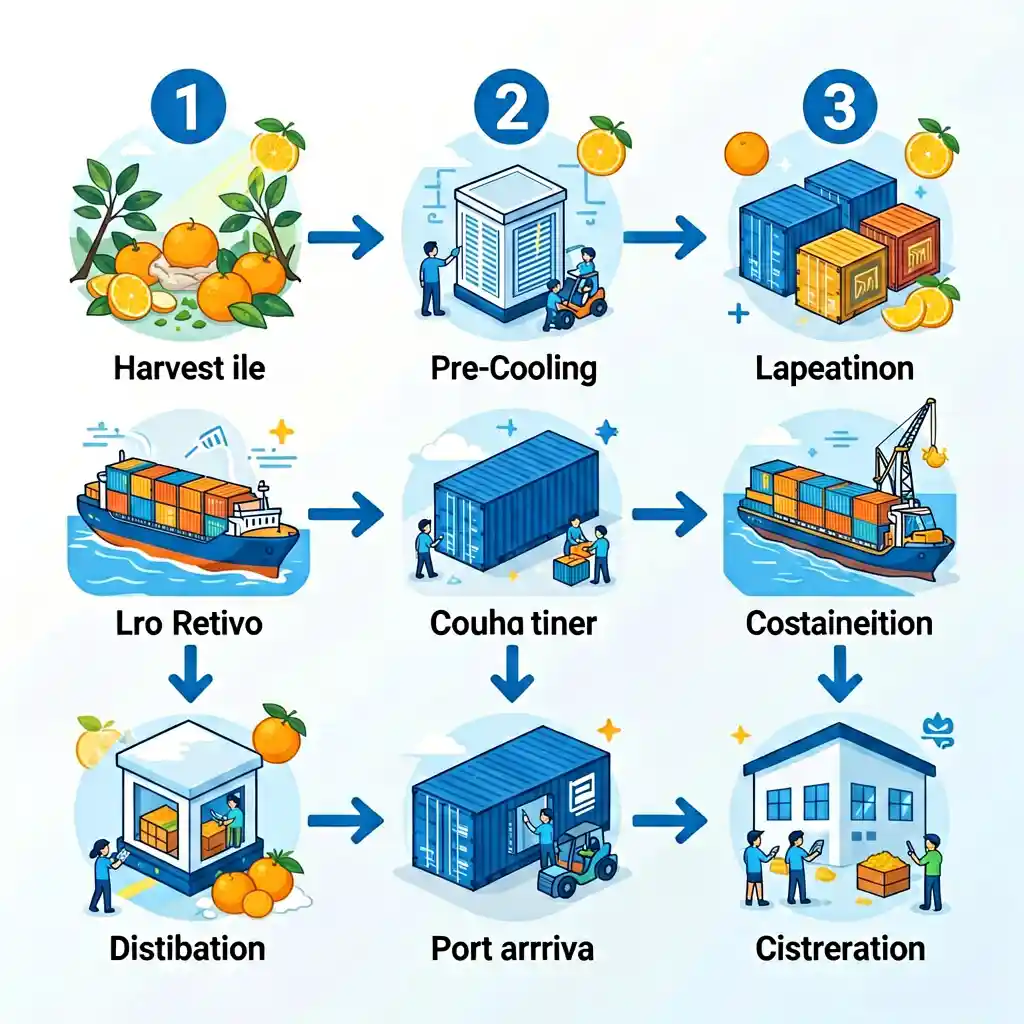
Contents: ① Cold Chain Fundamentals → ② Pre-Cooling Protocols → ③ Container Loading → ④ Transit Monitoring → ⑤ Port Handling → ⑥ Quality Loss Prevention → ⑦ Compliance & Documentation
① Cold Chain Fundamentals
The cold chain is the uninterrupted temperature-controlled supply chain from harvest to consumer. For citrus exports, maintaining the correct temperature range is critical:
| Parameter | Navels | Blood Oranges | Why It Matters |
|---|---|---|---|
| Storage temperature | 4-6°C | 6-8°C | Above 10°C: rapid quality decline; below 2°C: chilling injury |
| Relative humidity | 85-90% | 85-90% | Below 80%: weight loss, shriveling; above 95%: mold growth |
| Cold storage duration | Up to 12 weeks | Up to 8 weeks | Extended storage requires precise temperature control |
| Ethylene sensitivity | Moderate | Low | Ethylene causes discarding and flavor deterioration |
② Pre-Cooling Protocols
Pre-cooling is the most critical step in cold chain management:
Pre-Cooling Methods
- Hydrocooling: Cold water immersion (fastest, 2-4 hours)
- Force-air cooling: Cold air forced through packages (4-8 hours)
- Vacuum cooling: Not suitable for citrus (used for leafy vegetables)
- Room cooling: Passive cooling in refrigerated room (24-48 hours)
Pre-Cooling Requirements
Chinese packhouses must achieve:
- Core temperature: ≤6°C within 24 hours of harvest
- Surface temperature: ≤8°C at packaging time
- Uniform cooling: ±1°C temperature variation across container
③ Container Loading
Specification
Requirement
Pre-cooling temperature
Set to 4°C before loading
Air circulation
T-slot flooring for horizontal airflow
Humidity control
Humidifier or wet walls for 85-90% RH
Ethylene scrubbers
Activated alumina filters recommended
Temperature logging
Continuous monitoring with data download at destination
Loading Best Practices
- Load only pre-cooled fruit (core temperature ≤6°C)
- Stack pallets with 5cm gaps for air circulation
- Do not block air flow vents or T-slots
- Seal container immediately after loading
- Set reefer unit and verify operation before departure
④ Transit Monitoring
| Specification | Requirement |
|---|---|
| Pre-cooling temperature | Set to 4°C before loading |
| Air circulation | T-slot flooring for horizontal airflow |
| Humidity control | Humidifier or wet walls for 85-90% RH |
| Ethylene scrubbers | Activated alumina filters recommended |
| Temperature logging | Continuous monitoring with data download at destination |
Continuous temperature monitoring throughout transit is essential:
Monitoring Methods
- Data loggers: USB or wireless temperature recorders (mandatory)
- Real-time tracking: IoT sensors with cellular/satellite connectivity
- Manual checks: Temperature verification at port calls
Acceptable Temperature Range
| Condition | Temperature Range | Action Required |
|---|---|---|
| Ideal | 4-6°C | No action |
| Acceptable fluctuation | 3-7°C | Monitor, no adjustment |
| Warning zone | 2-3°C or 7-9°C | Adjust reefer unit |
| Critical - Chilling injury risk | <2°C | Immediate adjustment, inspect on arrival |
| Critical - Quality loss | >9°C | Immediate adjustment, expect shortened shelf life |
⑤ Port Handling
Port operations are high-risk periods for cold chain breaks:
Minimizing Temperature Excursions
- Pre-position containers: Park near loading docks, not in open yards
- Quick transfer: Load/unload within 30 minutes
- Shade protection: Use covered quays when available
- Temperature verification: Check data logger before acceptance
Documentation Requirements
Provide buyers with:
- Temperature log report (entire transit)
- Pre-cooling certificate
- Container inspection report
- Phytosanitary certificate
⑥ Quality Loss Prevention
Common Cold Chain Failures
| Problem | Causes | Prevention |
|---|---|---|
| Chilling injury | Temperature <2°C, long storage | Maintain 4-6°C, monitor regularly |
| Water loss | Low humidity, air movement | Maintain 85-90% RH, proper packaging |
| Mold growth | High humidity, damaged fruit | Control humidity, remove defective fruit |
| Color loss | High temperature, light exposure | Maintain correct temperature, opaque packaging |
| Fermentation | Temperature abuse, old fruit | Fresh harvest, proper cooling |
For storage techniques, see our storage guide.
⑦ Compliance & Documentation
Required Certificates
- Cold chain compliance certificate: Issued by packhouse
- Temperature log report: From data logger
- Phytosanitary certificate: From China Customs
- Quality inspection report: Third-party (SGS, BV)
Audit Requirements
Major buyers require cold chain audits:
- Facility inspection (packhouse, cold storage)
- Equipment calibration records
- Personnel training documentation
- Incident reporting procedures
Need Cold Chain Support?
GannanGrove provides comprehensive cold chain management:
- Pre-cooling within 6 hours of harvest
- Continuous temperature monitoring (data loggers)
- Reefer container pre-cooling verification
- Port handling coordination
- Complete documentation package
Summary: Cold Chain is Non-Negotiable
Maintaining cold chain integrity from Chinese orchard to foreign warehouse requires investment in pre-cooling facilities, monitoring technology, and trained personnel. The cost of cold chain management is small compared to the loss from a single failed shipment.
FAQ: Cold Chain Food Safety for Citrus Export
What is the ideal temperature for shipping citrus oranges?
Navels should be shipped at 4-6°C with 85-90% relative humidity. Blood oranges require slightly warmer conditions at 6-8°C. Maintaining these temperatures throughout the cold chain is essential for quality preservation.
How long can citrus oranges survive in a reefer container?
With proper cold chain management, navels can survive 21-28 days in transit. Blood oranges have slightly shorter shelf life at 18-24 days. Extended storage requires controlled atmosphere (CA) or modified atmosphere packaging (MAP).
What happens if the cold chain is broken during transit?
Temperature excursions above 9°C cause rapid quality loss: color fading, flavor deterioration, and shortened shelf life. Below 2°C causes chilling injury: pitting, water loss, and increased decay. Document any excursions with temperature logs for insurance claims.
Do I need special equipment for cold chain monitoring?
Yes. Data loggers are mandatory for commercial shipments. They record temperature (and often humidity) throughout transit. Modern IoT systems provide real-time monitoring with alerts for temperature deviations. USB data loggers cost $50-150; IoT systems cost $200-500 per container.
How do I verify cold chain compliance on arrival?
Download the data logger report and verify: (1) temperature stayed within 4-6°C throughout transit, (2) no excursions above 9°C or below 2°C, (3) humidity remained above 80%. Report any deviations to your supplier immediately.