Testing pesticide residues on imported citrus can make or break a shipment. One exceedance means rejection, fines, and lost revenue. This guide explains exactly how pesticide residue testing works for Chinese citrus exports — from sampling methods to EPA MRL compliance — so you can ensure your shipment passes every check.
| Quick Answer | Key Facts |
|---|---|
| Maximum Residue Limits (MRLs) | Varies by country; EU is stricter than US for some pesticides |
| Testing frequency | Per shipment or per batch; third-party inspection recommended |
| Key pesticides monitored | Imidacloprid, Captan, Diphenylamine, Thiabendazole |
| Acceptance criteria | All residues must be below EPA (US) or EU MRL thresholds |
| Testing turnaround | 3-5 business days for standard tests; 7-10 for full panels |
Contents: ① What is Pesticide Residue Testing → ② Key Pesticides Monitored → ③ EU vs US MRL Standards → ④ Sampling & Testing Methods → ⑤ Pre-Shipment Testing Requirements → ⑥ What Happens If Testing Fails → ⑦ GannanGrove Compliance
① What is Pesticide Residue Testing
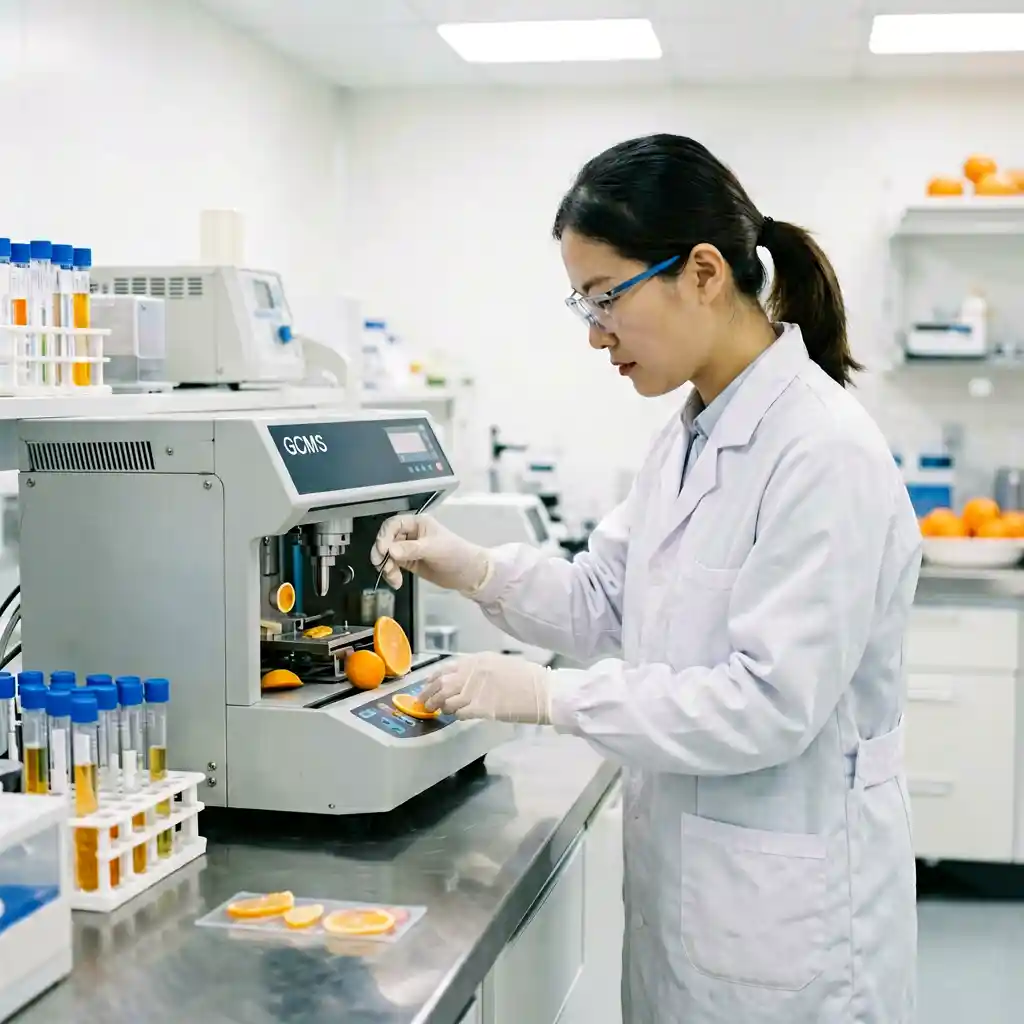
Pesticide residue testing analyzes fruit samples for trace amounts of agricultural chemicals used during cultivation and post-harvest treatment. For citrus exports to the US and EU, this testing is mandatory and non-negotiable.
The testing process involves:
- Sample collection: Representative samples taken from each batch/lot
- Extraction: Pesticides extracted from fruit tissue using solvents
- Cleanup: Sample purified to remove interfering compounds
- Analysis: GC-MS or LC-MS/MS instruments detect and quantify residues
- Reporting: Results compared against MRL thresholds
② Key Pesticides Monitored
Chinese citrus exporters must test for residues of commonly used pesticides. Here are the most frequently monitored compounds:
| Pesticide | Usage | EU MRL (mg/kg) | US EPA MRL (mg/kg) |
|---|---|---|---|
| Imidacloprid | Systemic insecticide | 0.01 (default) | 0.05 |
| Captan | Fungicide | 5.0 | 10.0 |
| Diphenylamine | Post-harvest treatment | 1.0 | 5.0 |
| Thiabendazole | Post-harvest fungicide | 1.0 | 0.2 |
| Triforine | Fungicide | 0.02 | Not registered |
| Pyrimethanil | Fungicide | 5.0 | 5.0 |
| Fluazifop-P | Herbicide | 0.01 | 0.5 |
| Acephate | Insecticide | 0.5 | 1.0 |
⚠️ Critical note: EU MRLs are generally stricter than US standards. Always test to the stricter standard to ensure dual-market compliance.
③ EU vs US MRL Standards
Understanding the difference between EU and US pesticide standards is essential for exporters targeting both markets:
| Factor | European Union | United States |
|---|---|---|
| Regulatory framework | EC No 396/2005 | FQPA (Food Quality Protection Act) |
| MRL philosophy | Precautionary principle | Risk-based assessment |
| Default MRL | 0.01 mg/kg (loth) | Varies by pesticide |
| Residue enforcement | Strict; zero tolerance for unregistered pesticides | More flexible; some tolerance exemptions |
| Testing laboratories | National reference labs + approved private labs | EPA-approved laboratories |
For more on EU import requirements, see our EU cold treatment guide.
④ Sampling & Testing Methods
Sampling Protocol
Proper sampling is critical for accurate residue analysis. The standard protocol involves:
- Random selection: Samples taken from different locations in the container
- Composite sampling: Multiple fruits combined into one sample
- Sample size: Minimum 1-2 kg per sample; 3-5 samples per lot
- Labelling: Each sample clearly labelled with lot number, date, and origin
- Chain of custody: Documented transfer from collection to laboratory
Testing Methods
Modern residue testing uses sophisticated analytical techniques:
- GC-MS/MS (Gas Chromatography-Mass Spectrometry): For volatile and semi-volatile pesticides
- LC-MS/MS (Liquid Chromatography-Mass Spectrometry): For polar and thermally labile compounds
- QuEChERS method: Quick, Easy, Cheap, Effective, Rugged, and Safe extraction technique
- Multi-residue screening: Tests for 200-400+ pesticides in a single run
⑤ Pre-Shipment Testing Requirements
Required Testing by Destination
| Destination | Testing Required | Timing | Lab Certification |
|---|---|---|---|
| United States | Multi-residue screening (200+ pesticides) | Before shipment departure | EPA-approved or ISO 17025 |
| European Union | Full residue panel + untargeted screening | Before shipment departure | National reference lab or ISO 17025 |
| Canada | Multi-residue screening | Before shipment | CCFP-approved laboratory |
| UAE/GCC | Basic residue panel | Before shipment | SASO-approved laboratory |
Testing Costs
- Standard multi-residue panel: $150-300 per sample
- Full screening (400+ pesticides): $400-800 per sample
- Express testing (48h result): +50% surcharge
- Retesting after corrective action: Full price applies
Get in touch with our compliance team for testing coordination.
⑥ What Happens If Testing Fails
Residue test failures can have serious consequences:
| Scenario | Consequence | Remediation |
|---|---|---|
| Marginal exceedance (<2x MRL) | Shipment held for retesting; possible re-export | Investigate source; adjust pest management |
| Significant exceedance (>2x MRL) | Refusal of admission; destruction or re-export | Full supply chain review; new testing protocol |
| Unregistered pesticide detected | Automatic rejection; potential FDA warning letter | Immediate supplier change; investigation |
| Repeated failures | Import alert; automatic detention without physical examination | Complete program overhaul; third-party audit |
Cost of a failed shipment can exceed $15,000-30,000 including product loss, freight, disposal, and legal fees.
For prevention strategies, see our sustainable farming guide.
⑦ GannanGrove Compliance
GannanGrove implements a comprehensive pesticide management program:
- Integrated Pest Management (IPM): Reduces pesticide reliance by 40-60%
- Pre-harvest interval compliance: Strict adherence to PHI for all treatments
- Pre-shipment testing: Every batch tested before loading
- Third-party verification: SGS/Bureau Veritas confirmation testing
- Residue database: Real-time tracking of all pesticide applications
- Supply chain audit: Annual orchard and packhouse inspections
Our testing results consistently show residue levels well below both EPA and EU MRL thresholds.
Summary: Testing is Non-Negotiable
Pesticide residue testing is a critical gatekeeper in citrus export. Understanding MRL standards, testing methods, and compliance requirements protects your shipment and your business. Work with suppliers who prioritize testing and transparency.
Need Testing Support?
GannanGrove provides comprehensive pesticide residue testing support:
- Pre-shipment testing: Every batch tested before loading
- Third-party verification: SGS/Bureau Veritas confirmation
- Compliance documentation: Full residue reports provided
- Expert consultation: Help with MRL compliance
FAQ: Pesticide Residue Testing for Chinese Citrus
How many pesticides are tested in a standard residue screen?
A standard multi-residue screening tests for 200-400+ pesticides simultaneously using GC-MS/MS and LC-MS/MS techniques. This comprehensive panel covers insecticides, fungicides, herbicides, and growth regulators commonly used in citrus cultivation.
What is the difference between EU and US pesticide standards?
The EU follows the precautionary principle with stricter MRLs (often 0.01 mg/kg default) and bans several pesticides registered in the US. The US uses risk-based assessment with higher tolerance levels for many compounds. Always test to the stricter standard for dual-market compliance.
How long does residue testing take?
Standard multi-residue testing takes 3-5 business days. Full screening (400+ pesticides) may take 7-10 days. Express 48-hour testing is available at a premium. Plan your testing schedule to align with shipment timelines.
What happens if my citrus fails residue testing?
Consequences range from shipment hold and retesting (marginal exceedance) to refusal of admission and destruction (significant exceedance). Repeated failures can trigger import alerts and automatic detention. Prevention through proper IPM and pre-shipment testing is far more cost-effective than dealing with failures.
How much does residue testing cost per shipment?
Standard testing costs $150-300 per sample, with full screening at $400-800. A typical 20ft container requires 3-5 samples, totaling $450-4,000 depending on scope. This is a small fraction of container value and essential for risk management.